



Testicular Sperm Extraction (TESE) is a method that removes sperm straight from a man’s testicular tissue. If you are unable to naturally release or produce enough quality sperm to have a biological child with your spouse, a doctor may suggest microTESE as part of Testicular sperm extraction for fertility treatment.
Men who are having their sperm extracted for IVF/ICSI can undergo TESA. It is synchronized with their female partner’s egg retrieval and performed under local anesthetic in the operating room or office. The testicle is punctured with a needle to extract tissue or sperm. Men who have obstructive azoospermia (s/p vasectomy) undergo TESA. Sometimes an open testis biopsy is required because TESA doesn’t give enough tissue or sperm.
In this guide, we will define the surgical procedure of TESE as one of the remedies and solutions for treating infertilityand discuss the details about it.
What is Testicular Sperm Extraction?
Testicular Sperm Extraction is a procedure in which sperm cells are extracted and either immediately used to fertilize eggs or preserved for use in future infertility treatments. To discover sperm cells, tissue is extracted from the testicle through a tiny incision (cut) and examined under a microscope in the lab.
Men who wish to have children after undergoing infertility-causing medications, like some cancer treatments, may find TESE helpful. One kind of sperm retrieval technique is TESE. Testicular sperm extraction is another name for it and is commonly used as part of infertility treatment in Iran for patients seeking advanced reproductive care.

Who needs Testicular Sperm Extraction?
The most suitable candidates for TESE are men who have been diagnosed with non-obstructive azoospermia, in which the testes can continue to produce some sperm even though there are no sperm in the ejaculate. It is especially advised in cases where other retrieval methods have not worked. In some cases, no sperm found after TESE can occur, especially in severe NOA, and further evaluation may be needed.
TESE also plays an important role in restoring male fertility when natural conception is not possible.
Preparation for Testicular Sperm Extraction
Prior to the retrieval of the eggs, sperm are typically collected for the IVF procedure. Before the collection, the man is reminded to refrain from having sex for two to five days, which is typically accomplished by masturbating. Stress might occasionally make it difficult for a man to provide a specimen when it’s needed.
Preparation for semen collection involves the following:
- The patient must avoid all sexual activity for two to seven days before the test.
- He must get a specimen by masturbating.
- Then, he must gather the whole specimen into a sterile, clear plastic container with a yellow cover.
- And finally, he is supposed to write his last name, first name, birthdate, and the time and date of collection on the container label.
How Is TESE Performed?
There are two methods for doing a standard TESE. Many seminiferous tubules can be obtained from a single tunica albuginea incision. As an alternative, samples can be taken by making numerous tiny incisions in the tunica albuginea during biopsies.
The surgical procedure is carried out under local or general anesthesia. Sperm-containing tissue is gently removed from the testicle after a little incision is made. To separate viable sperm for use in IVF or ICSI in Iran, the tissue is treated in a lab. Depending on the complexity and quantity of samples needed, the process usually takes 30 to 60 minutes.
Testicular Sperm Extraction Methods
Extraction of non-ejaculated sperm cells from the testicular tissue, where they are created, is the aim of testicular sperm collecting. Collecting sperm from the testis may provide sufficient and higher-quality sperm for microinjection (ICSI) in certain men whose ejaculated sperm cells are of inappropriate quality.
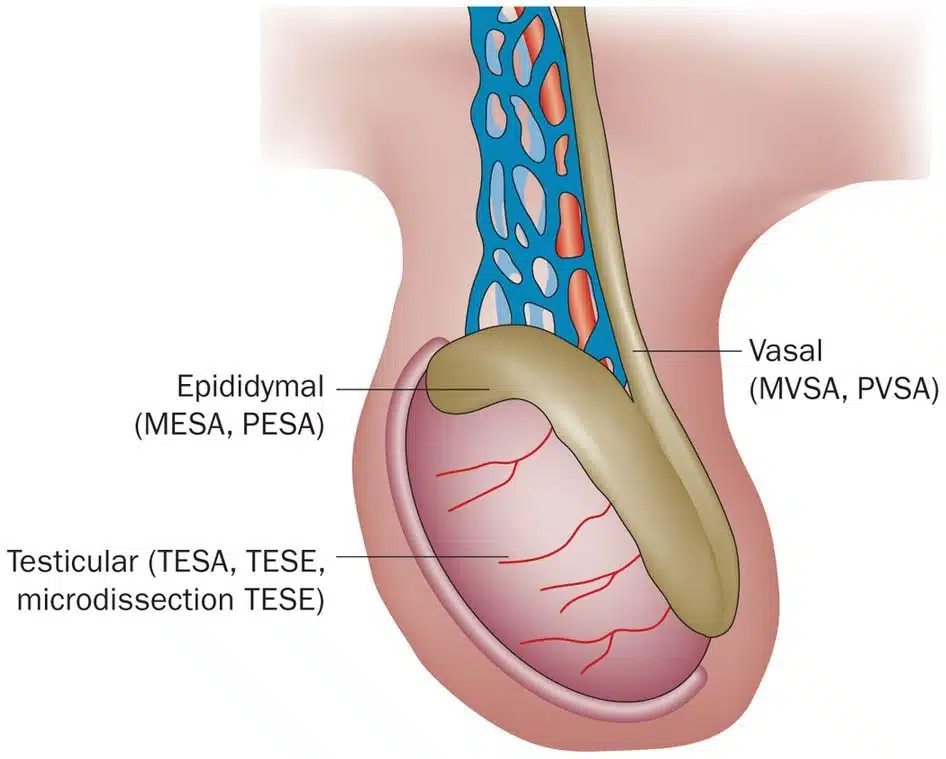
The cause of the issue determines the sort of treatment, and there are five options, as follows:
- Percutaneous epididymal sperm aspiration (PESA)
- Microsurgical epididymal sperm aspiration (MESA)
- Testicular sperm aspiration (TESA)
- Testicular sperm extraction (TESE)
- Microscopic testicular sperm extraction (Micro TESE)
- Multifocal TESE
Conventional TESE
Conventional TESE (cTESE) is based on one or more open testicular biopsies that are performed without magnification.
Microdissection TESE
In contrast to Conventional TESE, microdissection TESE (mTESE) uses a microsurgical method using an operating microscope to find and remove seminiferous tubules that are more likely to contain sperm.
The procedure is carried out under general anesthesia, and sperm cells are visible under a specialized microscope. The likelihood of obtaining more and better-quality sperm from the testicular tissue has been greatly increased using Micro TESE. Additionally, it is regarded as one of the most dependable ways to harvest sperm because only a tiny amount of testicular tissue is taken.
Multifocal TESE
In Multifocal TESE, the sample is taken from multiple locations within the testicle.This increases the chance of finding pockets of active sperm production, since sperm may not be evenly distributed in NOA.
Comparing TESE with Other Sperm Retrieval Methods
Percutaneous epididymal sperm aspiration (PESA) is a common method for retrieving epididymal sperm in males with obstructive azoospermia. Testicular sperm are extracted using needle aspiration biopsy (NAB) if PESA is unsuccessful.
Testicular sperm retrieval is necessary in males with non-obstructive azoospermia because there won’t be any sperm in the epididymis. The first option is to use NAB for percutaneous retrieval.
If that doesn’t work, single seminiferous tubule (SST) or microdissection TESE procedures are used for testicular sperm extraction (TESE) from open microsurgical biopsies. It is best to start with the least complicated and intrusive operation.
Benefits and Risks of TESE
There is no proof that using surgically extracted sperm will reduce your chances of becoming pregnant or endanger the health and welfare of any offspring you may conceive.
Sperm retrieved surgically may not fertilize as well, according to research, although this could be because certain sperm are of inferior quality.
Recovery after TESE
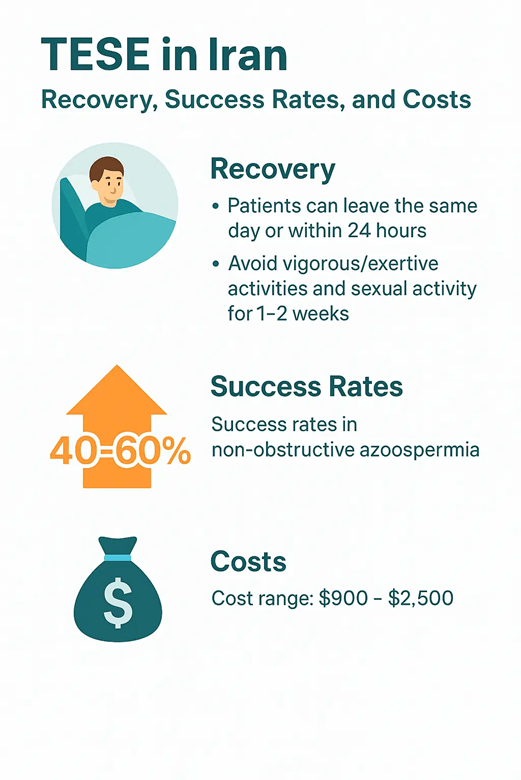
Patients are frequently released the same day or within 24 hours following TESE, which is typically an outpatient or short-stay operation. For a few days, there can be minor bruising, swelling, or discomfort. For one to two weeks, patients are recommended to refrain from vigorous exertion and sexual activity.
Follow-up appointments guarantee appropriate healing and evaluate the success of sperm retrieval. Many patients search for guidance on Testicular sperm extraction recovery during this period, and in some cases, individuals consider procedures such as Testicular sperm extraction after vasectomy if fertility is desired later in life.
Success rate of Testicular Sperm Extraction
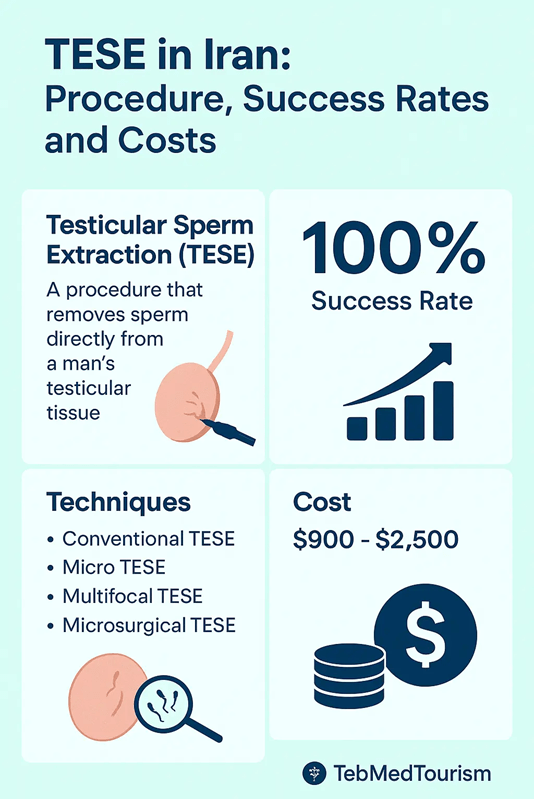
Testicular sperm extraction (TESE) success rates vary greatly depending on the diagnosis; for obstructive azoospermia (OA), they are close to 100%, while for non-obstructive azoospermia (NOA), they are between 40 and 60%.
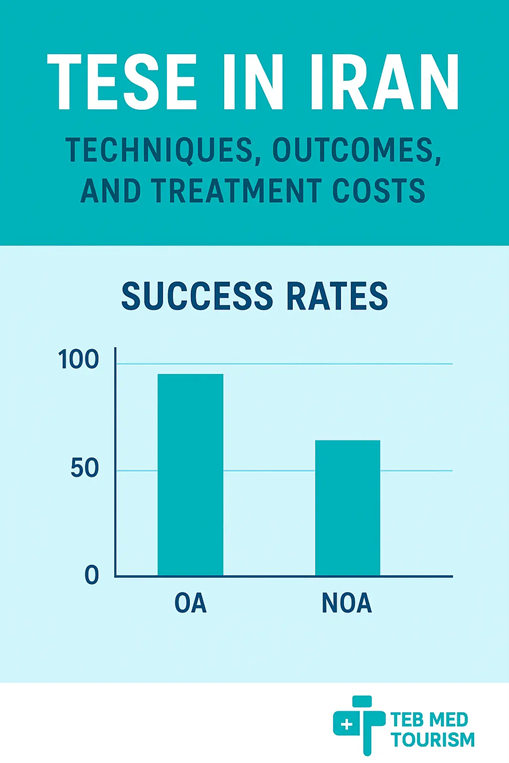
In NOA cases, micro-TESE frequently achieves greater rates (up to 60%) by enabling precision searching. Pregnancy rates with Intracytoplasmic Sperm Injection (ICSI) are comparable to those with ejaculated sperm if sperm is successfully recovered; however, success is largely dependent on the quantity and quality of sperm found.
Cost of TESE in Iran
TESE in Iran typically costs between $900 and $2,500 USD. The Testicular sperm extraction cost varies based on the following factors:
- The facilities of the particular treatment facility.
- The complexity of each patient’s unique situation.
- The equipment that is used.
- The experience level along with the expenses of the surgery.
Iran is regarded as one the most a cost-effective destinations for fertility treatments such as IVF in Iran, Sperm Donation in Iran, and TESE, since it provides excellent medical care at a far lesser cost than many other nations, such the US or the UK. Numerous clinics as provide all-inclusive packages that may include consultations, prescription medications, and the procedure itself.
TebMedTourism, with years of experience in providing medical tourism services as both a provider and facilitator—especially in infertility treatments such as IVF, surrogacy, and TESE—offers all the necessary services for both accommodation and the treatment process.
Conclusion
The genetic components required to fertilize the egg are found in sperm, which are unique cells created in the testicles. Sperm issues, however, account for the majority of male infertility cases. A specific number of sperm should be extracted from the man in order to treat infertility.
Testicular Sperm Extraction, known as TESE, is one of the most common and effective methods for infertility treatment, and Iran is one of the best and most cost-effective destinations for this surgical procedure, especially for those seeking advanced infertility treatment in Iran.