




In order to undergo the IVF process, there are several IVF protocols that can be used to stimulate the ovaries by the use of certain medications and prepare them for in vitro fertilization (IVF). This process is done in order to reach an optimal number of eggs to be fertilized and make healthy embryos so that at least one pregnancy occurs.
There are different types of IVF protocols, and each of them can be suitable for certain patients. To choose the best IVF protocol, you need to consult with your fertility doctor to review your medical records (woman’s age, response to the medication, and the outcome of previous attempts) and decide which protocol is right for you.
IVF Protocols
To stimulate the ovaries, regulate hormone levels, and prepare eggs for retrieval during the in vitro fertilization (IVF) process, IVF protocols are treatment plans that employ particular fertility medications.
Producing multiple mature eggs, improving the likelihood of a healthy embryo, and increasing the likelihood of pregnancy are the objectives of these protocols. Each of the various IVF protocols is chosen according to the patient’s age, ovarian reserve, medical background, and past reaction to fertility drugs. The most popular IVF procedures are as follows.
Antagonist Protocol (Short Protocol)
This is the most commonly used protocol for IVF and is also known as the IVF short protocol. It is effective for most of the patients and contains the lowest number of injections.
In this protocol, you will be instructed to use birth control pills before starting the IVF cycle, which is an important part of the IVF timeline. For 10 days you will be taking follicle-stimulating hormone (FSH) and will have luteinizing hormone (LH) injections.
Around day 5, the Gonadotropin-Releasing Hormone (GNRH) antagonist is used in order to prevent premature ovulation. Your doctor may use “Lupron trigger” or “dual trigger” medicines to stimulate the maturation of the eggs before the retrieval process begins.
In this way, the risk of Ovarian Hyper-Stimulation Syndrome (OHSS) decreases significantly. The IVF short protocol is considered one of the most widely used IVF medication protocols worldwide and is commonly offered in the best IVF clinics around the world.
Lupron Down Regulation (Long Lupron Protocol)
This protocol is mostly used in the younger patients or those who had poor-quality embryos in their previous protocols. It is commonly referred to as the long Lupron protocol. You will be prescribed to take birth control pills before starting the cycle of IVF.
On the third week your doctor will order an injectable medication called Lupron. By undertaking Lupron injections, your pituitary gland temporarily stops secretion of FSH and LH hormones.
Injections can control the cycle and prevent premature ovulation of the follicles. The long Lupron protocol remains one of the traditional IVF medication protocols used for controlled ovarian stimulation and may influence the overall IVF success rate depending on patient conditions.

The Micro-dose Lupron Flare Protocol
The micro-dose Lupron is prescribed for those patients who had a poor response to their previous protocols due to their high reproductive age or low ovarian reserve. The flare protocol is used to make the ovaries quickly respond to the stimulation and produce enough mature eggs to be used in the IVF process.
The lower dose of Lupron stimulates the body’s natural FSH production instead of suppressing it. Taking micro-dose Lupron for the stimulation phase continues until the injection of the Human Chorionic Gonadotropin (HCG) trigger.
This protocol usually makes the IVF process work by enhancing the response speed of the ovaries and is considered among specialized IVF medication protocols for poor responders during the IVF journey.
Estrogen Priming Protocol
Women who respond poorly to the short protocols and have low ovarian reserve may enhance their ovaries’ response by using this protocol, also known as the estrogen priming protocol IVF.
The estrogen priming protocol synchronizes more follicles for retrieval. For this aim, your fertility doctor may suggest you undergo an estrogen medication and probably a few days of GnRH antagonist before you start the IVF cycle.
The use of estrogen priming for IVF can help improve follicle synchronization and response to stimulation medications, especially in women with diminished ovarian reserve, which may improve IVF success rate outcomes.
Mini-IVF or Micro-IVF Protocol:
Some experts believe that minimal stimulation may offer some benefits instead of using traditional treatment. The related doctor may prescribe fertility pills or medications in very low dosages in order to retrieve just one or two eggs each time.
The disadvantage of using this protocol is that it produces just a few healthy eggs, and it needs more egg retrievals for achieving the goal of getting pregnant. This is sometimes discussed when considering IVF drawbacks compared to conventional stimulation protocols.
What is a typical IVF protocol?
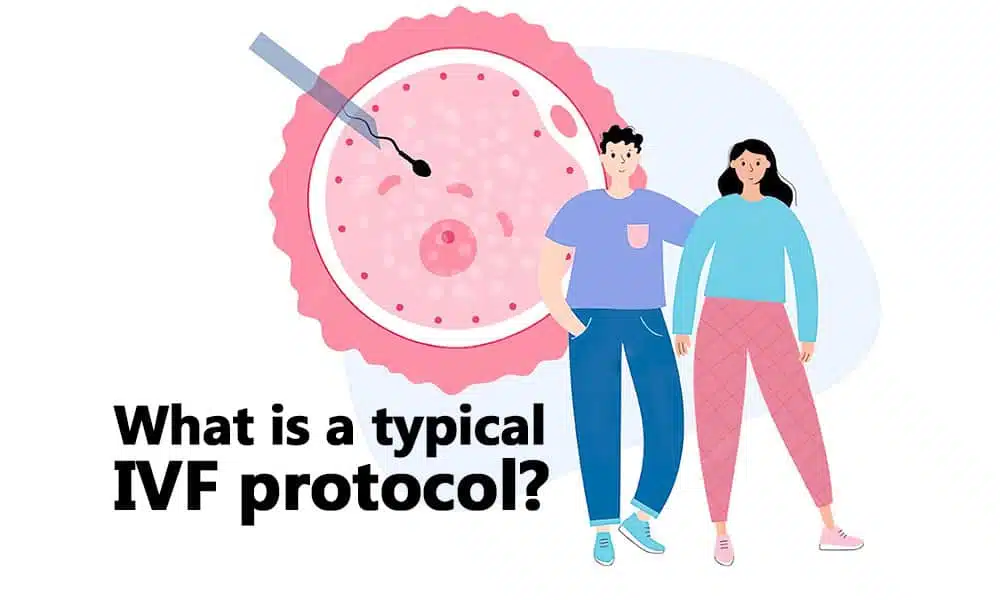
The most typical IVF protocol is the antagonist, or IVF short protocol. This method involves the fewest number of injections, and it is a mostly effective protocol for all patients. In this protocol, you may be recommended to use birth control tablets before starting an IVF cycle.
You need to use follicle-stimulating hormone (FSH) and luteinizing hormone (LH) injections for 10 days. From around the fifth day, you should add a gonadotropin-releasing hormone (GnRH) antagonist in order to prevent premature ovulation.
Before egg retrieval, your doctor may prescribe a “Lupron trigger” or “dual trigger” to stimulate the final maturation of the oocytes and get them ready to be harvested. It also decreases the risk of Ovarian Hyperstimulation Syndrome (OHSS).
After embryo transfer, patients often look for positive symptoms after embryo transfer as early signs of implantation success.
This protocol is usually used in younger patients or those who have not seen a good response from the other IVF medication protocols, including the long Lupron protocol. By the third week, your doctor will prescribe you an injectable medication called Lupron.
This medication temporarily stops the pituitary gland in the brain from releasing FSH and LH. By this method, the FSH and LH levels from the injectable will control your cycle and prevent premature ovulation of the follicles.
Which is better: short or long IVF protocol?
Both short and long protocols of IVF are practical ways for stimulating egg follicles’ growth and retrieving them for insemination. The long IVF protocol, which is known as the GnRH agonist long protocol, will take about 4-5 weeks.
You will start taking medications on the 21st day of your menstruation cycle, which is known as ‘down regulation’ and aims to suppress ovarian function. Typically, after 10-14 days of suppressing the ovaries, the second type of medication, which is gonadotrophins (typically FSH or hMG), will be started, and it will be administered for 12-14 days.
Gonadotrophins stimulate follicle growth, and you will be checked by ultrasound every 3-4 days during this process to monitor the response of follicles to the medications and determine the time of egg retrieval.
A short protocol will take 2 to 3 weeks and usually consists of 10–12 days of medication before egg retrieval. In the IVF short protocol, there is no suppression of ovarian functions.
You should take gonadotrophins (FSH or hMG) for about 10-12 days, and while the follicles are growing, you need to be checked by your doctor through internal scans every 3-4 days.
The long protocol was the first IVF protocol that was used for patients, and after that a short protocol was developed. Studies have shown that there is little difference in the results of long and short IVF protocols.
However, a short IVF protocol is less prone to Ovarian Hyperstimulation Syndrome (OHSS). There is no fixed protocol for all patients, and treatment plans should be arranged according to the individual’s medical history and follicle prognosis. TebMedTourism’s doctors will carefully consider the medical condition of each patient and then arrange the best IVF protocol, including options for IVF gender selection when medically appropriate.
What is the best IVF protocol?
It is fair to say that the best IVF protocol is neither maximal nor minimal; instead of them, it should be optimal based on the patient’s age, medical history, basal follicle count, Anti-Mullerian Hormone (AMH) levels, and family building aims.
Selecting between options like the IVF short protocol, long Lupron protocol, or estrogen priming protocol IVF depends on individual fertility characteristics.
Before starting the IVF cycle, you have to consult with your fertility doctor to find out which protocol best fits your condition. In TebMedTourism company, by introducing you to our professional team, we pave the way for your fertility treatment, including services such as IVF in Iran with affordable IVF costs compared to many other countries.
What is the best IVF protocol for a poor responder?
To maximize the IVF success rate, it is preferred to get multiple high-quality eggs. However, some women are poor responders to ovarian-stimulating drugs. After taking stimulating medications, they might mature a low number of follicles that lower the chance of IVF success.
Protocols such as the flare protocol or estrogen priming for IVF may be recommended depending on ovarian reserve and previous responses to IVF medication protocols.
Therefore, women with the low ovarian response should be treated with a special IVF protocol that helps them mature more follicles. In long IVF protocol, some women are “over-suppressed” or are poor responders due to some other reasons. A “stop Lupron” protocol is one of the options to get a better ovarian response when using stimulating medications.
In this protocol, Lupron will be used at the lower dose of 5 units daily instead of using 10 or 20 units, and then it is completely stopped after the woman gets her period. “Flare protocol” is another IVF protocol that is started on the second day of the cycle and tries to take advantage of an initial “flare-up” response of FSH and LH, which are released from the woman’s pituitary gland.
In this protocol, birth control pills are usually used for one month before the flare in order to not have any leftover cysts because they can be reactivated by the high LH level. Continuing Lupron for more than 3 days suppresses the pituitary gland so that it has a low output of FSH and LH.
The aim of this protocol is that Lupron causes the release of a large amount of FSH and LH that will suddenly start (flare-up) the follicles, and as a result, we might have better ovarian stimulation with more mature follicles for IVF.
Does IVF protocol affect egg quality?
IVF protocol usually does not have a major effect on egg quality; however, a bad choice of the protocol can lead to diminished egg quality or further health complications. An unsuccessful IVF outcome can sometimes be related to the wrong type of IVF medication protocols, whether it is the IVF short protocol or the long Lupron protocol.
Stimulation protocol helps increase fertility in women, especially when they are at advanced ages. Low egg quality can lead to genetic defects in the embryo, which results in a higher chance of IVF failure or miscarriage.
When the eggs are stimulated, ovaries are supposed to produce more than one egg per cycle. Then the embryos are created, and if there is more than one healthy embryo, they can be frozen for future use.
However, in case no healthy embryo is found, there is a need for another IVF cycle. The type of protocol and medication adjustment should be decided based on each patient’s ovarian reserve.
Does long protocol IVF produce more eggs?
Studies have shown that there is little difference in the result of IVF protocols, but the short protocol has less risk for OHSS compared to the long protocol. In the long Lupron protocol, the doctor tries to stimulate the patient’s ovaries by using certain drugs one week before her menstruation cycle starts.
These medications suppress two hormones called Follicle Stimulating Hormone (FSH) and luteinizing hormone (LH), which are made in the pituitary gland and cause your ovary to make eggs. By suppressing these two hormones, the ovaries become suppressed and do not make eggs, and the ovarian hormone is called estradiol.
Once the ovarian function has been suppressed, usually after 10-14 days, you will start taking the second set of medication, which is named gonadotrophins and should be administered for 12-14 days.
Gonadotrophins stimulate follicles’ growth and prepare them for egg retrieval. During this time, you will be monitored every 3-4 days to evaluate the medication effects on your follicles.
Conclusion
IVF protocols play a pivotal role in the success of in vitro fertilization by serving as personalized treatment plans to stimulate the ovaries, regulate hormones, and retrieve mature eggs, thereby maximizing the chances of producing healthy embryos and achieving pregnancy.
Among the various options, the antagonist protocol (commonly known as the short protocol) remains the most widely used and preferred IVF protocols in 2026. It offers a shorter duration (typically 2–3 weeks), fewer injections, comparable success rates to other approaches, and significantly reduced risk of Ovarian Hyperstimulation Syndrome (OHSS).
The long Lupron (agonist) protocol is still suitable for younger patients or those with prior poor embryo quality, though it involves longer treatment and higher OHSS risk. For poor responders, specialized IVF protocols such as the microdose Lupron flare or estrogen priming can enhance ovarian response and egg yield.
Ultimately, no single protocol is universally best; the optimal choice is individualized based on age, ovarian reserve (AMH levels, antral follicle count), treatment history, and fertility goals. This tailored approach, combined with close monitoring, is key to improving IVF success rates, minimizing complications, and supporting healthy pregnancies.